Polyphonic audio to MIDI:
notes or instrument tracks?
Polyphonic audio to MIDI can produce overlapping note drafts, but this local converter does not assign them to separate source instruments; start with separate recordings or stems when you need a guitar part and a piano part. findings.json · browser-verification.json
The four tests use Local note transcription with Balanced on fixed human-recording excerpts, with the unchanged original single-pitch detector retained as an explicitly offline baseline. protocol.json · offline-conversion.json
1. Check notes and instrument routing separately
Every downloaded test file is Format 0 with one track and zero-based note-channel field 0, without source track names or program-change messages. findings.json · browser-guitar.mid · browser-piano.mid · browser-mix.mid · browser-offset-mix.mid
Overlapping notes in that shared channel do not identify which instrument produced each note or automatically create separate source parts. findings.json · detector-snapshot.js
| Input | Reference attacks | Output events | Matched | Missed | Unmatched output | Maximum output overlap |
|---|---|---|---|---|---|---|
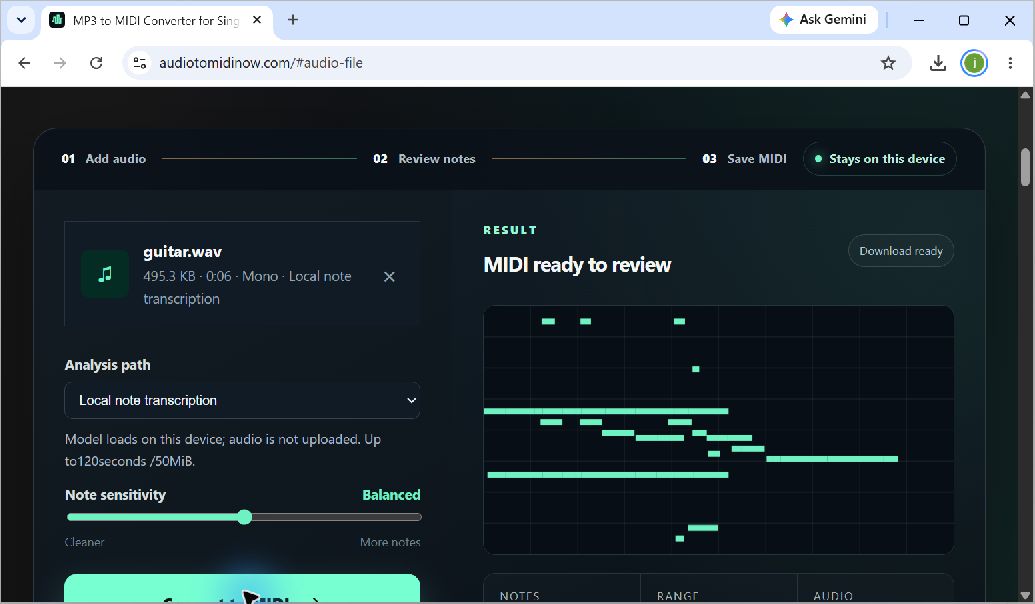
| guitar | 17 | 55 | 16 | 1 | 39 | 6 |
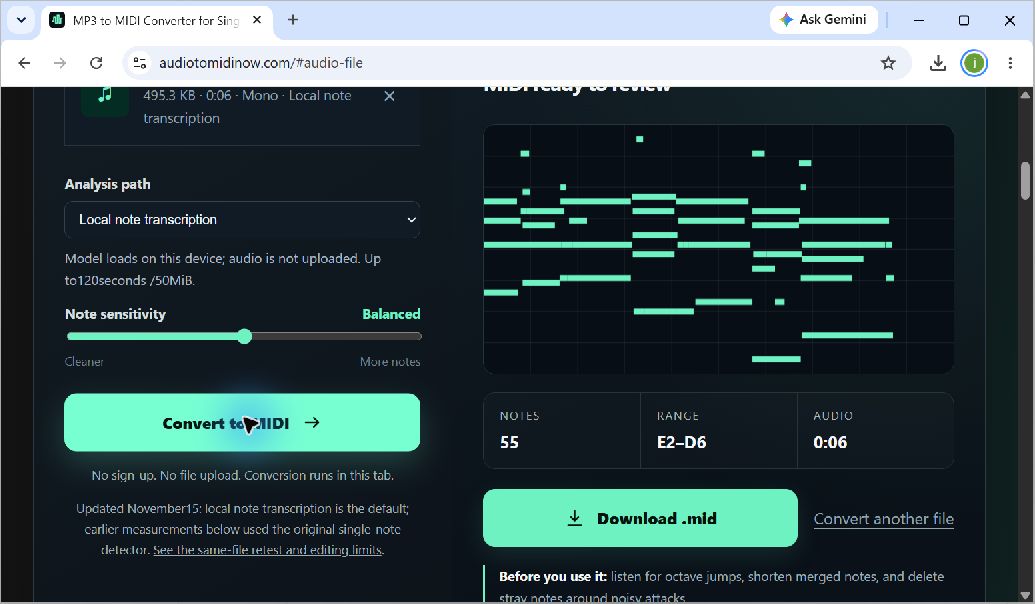
| piano | 22 | 55 | 21 | 1 | 34 | 7 |
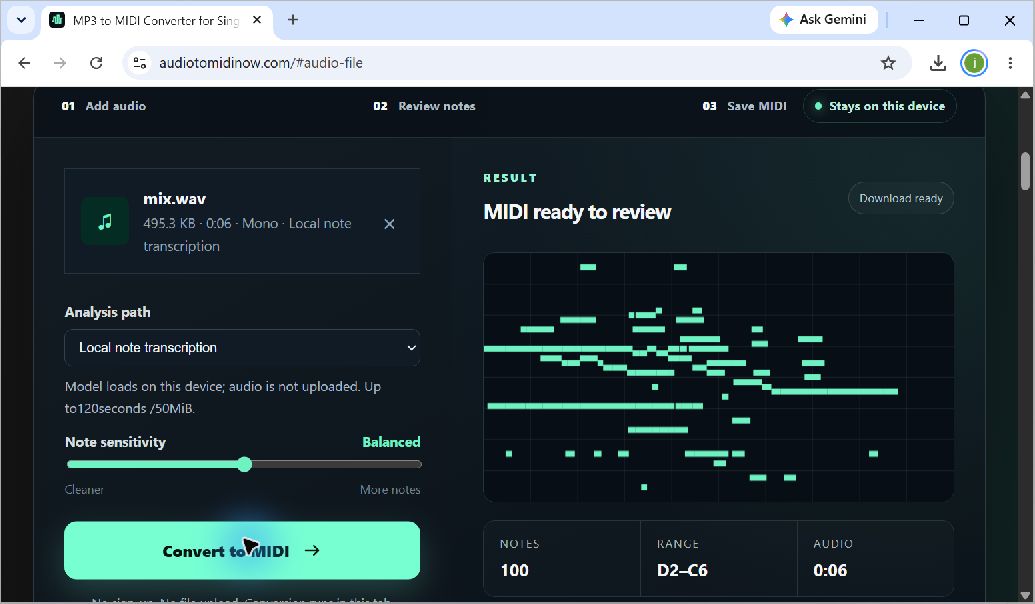
| mix | 39 | 100 | 31 | 8 | 69 | 8 |
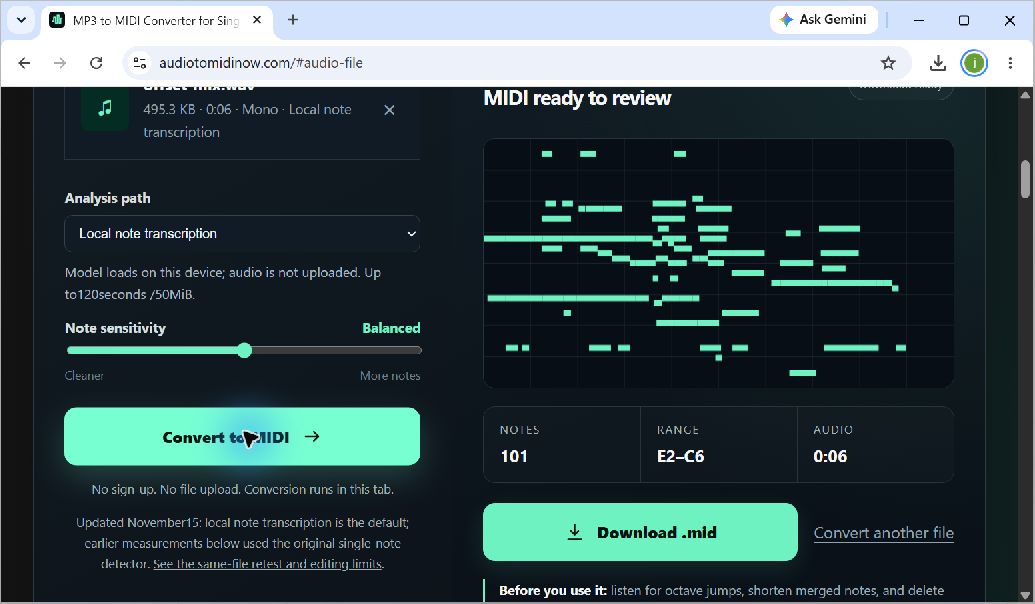
| offset-mix | 39 | 101 | 28 | 11 | 73 | 9 |
2. First comparison: keep the sources separate
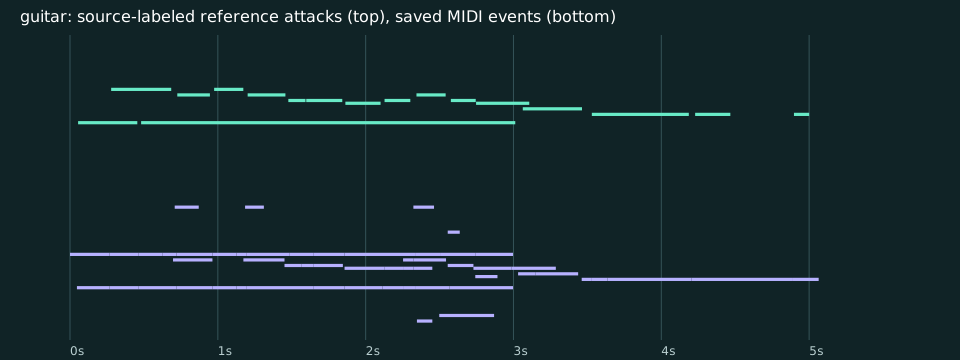
The guitar recording produces 55 events: 16 match its 17 reference attacks, 1 attack is missed and 39 events are unmatched. findings.json · browser-guitar.mid · browser-guitar-notes.csv · ref-guitar.json
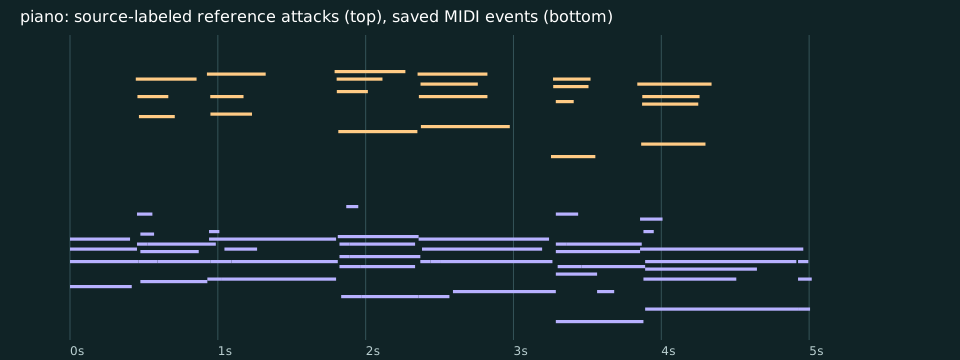
The piano recording also produces 55 events, but matches 21 of 22 reference attacks, with 1 missed and 34 unmatched events. findings.json · browser-piano.mid · browser-piano-matches.csv · ref-piano.json
Maximum exported note overlap is 6 for guitar and 7 for piano, while their reference key-held overlaps reach 2 and 4, so the larger output ceilings are not complete-chord accuracy scores. findings.json · browser-guitar-notes.csv · browser-piano-notes.csv
Among matched attacks, median absolute reference-end error is about 93 milliseconds for guitar and 333 milliseconds for piano, leaving note lengths to inspect even when starts pass. findings.json · browser-guitar-matches.csv · browser-piano-matches.csv
3. Second comparison: add the same two waveforms
The direct mixture adds the exact two quarter-amplitude components without clipping, normalization or any change to the note detector settings. protocol.json · inputs.json · generate.py
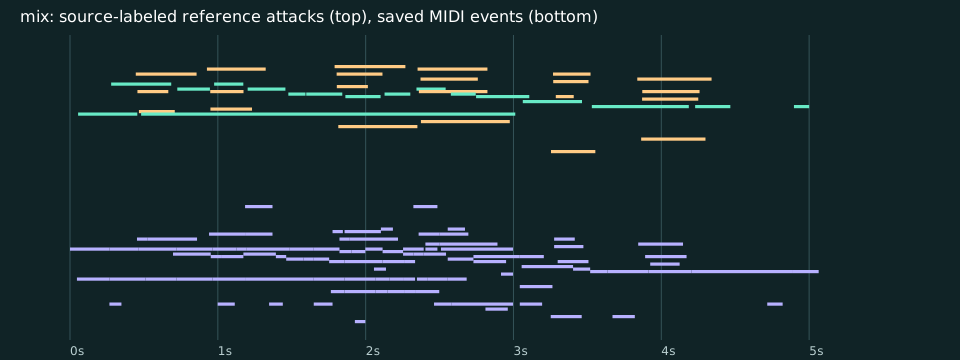
That mixture exports 100 events for 39 reference attacks: 31 match, 8 are missed and 69 output events remain unmatched. findings.json · browser-mix.mid · browser-mix-matches.csv · ref-mix.json
Submitting the two components separately accounts for 37 of their combined 39 attacks, 6 more than the direct mixture under this fixed matching rule. findings.json · result-table.csv
The scorer associates 16 mixture matches with guitar references and 15 with piano references, compared with 16 and 21 for the isolated inputs. findings.json · browser-mix-matches.csv
Those source labels come from matching against the known reference files, not from instrument identities emitted by the transcription model. browser-mix-matches.csv · score.py
4. Third comparison: move one component, keep its notes
The timing control moves the piano component later by 0.25 seconds, retaining the same gains and reference attacks in an equally long file. protocol.json · generate.py · inputs.json · ref-offset-mix.json
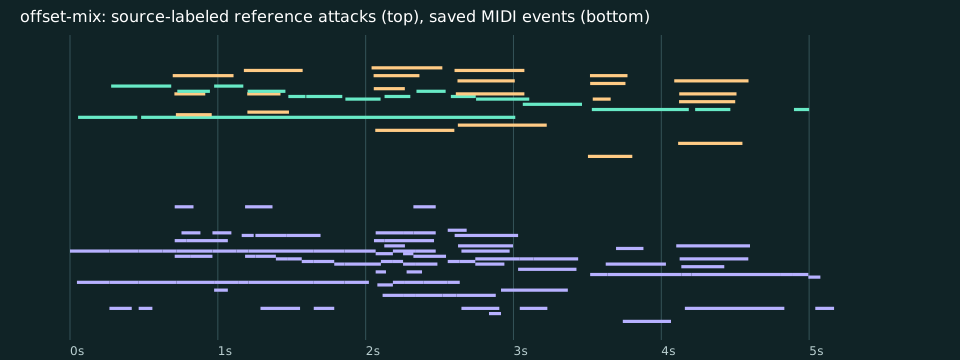
The offset mixture exports 101 events: 28 of 39 attacks match, 11 are missed and 73 events are unmatched. findings.json · browser-offset-mix.mid · browser-offset-mix-matches.csv
Compared with the direct mixture, exported overlap rises from 8 to 9 and event count increases by 1, yet strict matches fall by 3. findings.json · result-table.csv
The offset scorer still associates 16 matches with guitar references but only 12 with piano references, so the three-match decrease is in piano-reference associations rather than a model-supplied instrument label. findings.json · browser-mix-matches.csv · browser-offset-mix-matches.csv
This is a controlled change in relative timing, not a live-latency test or proof of a single cause for any changed detection. protocol.json · runtime-comparison.json
5. Keep the baseline and the runtime difference visible
On these same four inputs, the original single-pitch detector exports 2, 0, 2 and 2 events respectively, with no strict attack matches and no output overlap above one. offline-scores.json · baseline-guitar.mid · baseline-piano.mid · baseline-mix.mid · baseline-offset-mix.mid
That is a comparison of processing paths on these windows, not a sensitivity setting giving the original detector new polyphonic capability or a general ranking of products. protocol.json · detector-snapshot.js · offline-conversion.json
Three browser files are byte-identical to their offline counterparts, but the piano differs at byte offset 122: zero-based note 12 has velocity 56 in Chrome and 55 offline, while its pitches, starts and durations remain identical. runtime-comparison.json · browser-piano.mid · offline-piano.mid
The independently regenerated offline run matches all 26 recorded artifacts exactly; it proves that declared offline run, not equality between every browser and offline file or the cause of the velocity difference. offline-reproduction.json · runtime-comparison.json
6. Match the evidence to its limits
A strict match requires the same integer MIDI pitch and an onset within 50 milliseconds, choosing the nearest unused output in reference order without fitting a shift or crediting an octave substitute. protocol.json · score.py
These crops also carry in two guitar and three piano reference notes from before the cut, so unmatched events cannot automatically all be called invented pitches. ref-guitar.json · ref-piano.json · ref-mix.json · score.py
Guitar annotations have per-string pitch and timing uncertainty, and the inherited piano clock calibration and hardware key-release times do not describe every pedal-held acoustic decay. ATTRIBUTION.md · guitar-source-provenance.json · piano-source-provenance.json · protocol.json
The excerpts reuse archived human performances from unrelated pieces and recording setups, so their controlled addition is not a newly recorded duet, a full band or an orchestral accuracy benchmark. ATTRIBUTION.md · protocol.json
The source review records ten observed ordinary Google results with unread bodies kept unknown, and does not establish a US ranking, exclusive functionality or web-wide uniqueness. research-review.json
7. Reproduce the counts before arranging
Download the raw recordings, reference labels and MIDI below, then run the included score.py and compare-runtime.py with Python 3 to reparse the notes, redo the fixed matches and regenerate the tables and event-derived piano rolls. README.md · score.py · compare-runtime.py · result-table.csv
Use the separate-input drafts when source provenance matters, retain their recording-to-file mapping, and verify the notes against those recordings before assigning sounds in your editor. inputs.json · browser-verification.json · findings.json
8. Choose the next check
For the handoff, separate track containers from MIDI channels, plan source-checked MIDI cleanup, and read the earlier five-condition audio-to-MIDI panel as a historical original-detector benchmark. findings.json
Try your own isolated part in the browser converter, keep the raw MIDI and compare it with the recording. browser-verification.json
Evidence downloads
- README.md
- ATTRIBUTION.md
- protocol.json
- inputs.json
- findings.json
- result-table.csv
- browser-verification.json
- browser-scores.json
- runtime-comparison.json
- offline-scores.json
- offline-reproduction.json
- sentence-audit.json
- sentence-ledger.json
- claims.json
- primary-sources.json
- research-review.json
- dedup-review.json
- generate.py
- midi_reader.py
- score.py
- compare-runtime.py
- rerun-worker.mjs
- detector-snapshot.js
- offline-conversion.json
- guitar-original.jams
- piano-original-reference.mid
- guitar-source-provenance.json
- piano-source-provenance.json
- guitar.wav
- ref-guitar.json
- browser-guitar.mid
- offline-guitar.mid
- baseline-guitar.mid
- browser-guitar-notes.csv
- browser-guitar-matches.csv
- browser-guitar-piano-roll.svg
- browser-guitar.jpg
- browser-guitar-ui.txt
- piano.wav
- ref-piano.json
- browser-piano.mid
- offline-piano.mid
- baseline-piano.mid
- browser-piano-notes.csv
- browser-piano-matches.csv
- browser-piano-piano-roll.svg
- browser-piano.jpg
- browser-piano-ui.txt
- mix.wav
- ref-mix.json
- browser-mix.mid
- offline-mix.mid
- baseline-mix.mid
- browser-mix-notes.csv
- browser-mix-matches.csv
- browser-mix-piano-roll.svg
- browser-mix.jpg
- browser-mix-ui.txt
- offset-mix.wav
- ref-offset-mix.json
- browser-offset-mix.mid
- offline-offset-mix.mid
- baseline-offset-mix.mid
- browser-offset-mix-notes.csv
- browser-offset-mix-matches.csv
- browser-offset-mix-piano-roll.svg
- browser-offset-mix.jpg
- browser-offset-mix-ui.txt
- manifest.json