Change MP3 to MIDI: Single-Note Source-History Tests
To change MP3 to MIDI, add a clear single-note recording to the browser converter, press Convert to MIDI and inspect the downloaded notes; if you have the original recording, compare it directly instead of expecting a WAV copy or a higher-bitrate resave to restore the same draft. Data
This method performs monophonic pitch detection, one note at a time; simultaneous polyphonic transcription requires a different processing path. Data
2. Read the source history, not only the file label
We took four consecutive five-second windows, A through D, from the first twenty seconds of one archived human GuitarSet microphone recording, fixing the windows before conversion and using no synthesized replacement instrument. Data
Each window follows seven declared paths: original WAV, direct 192 kb/s MP3, first 32 kb/s MP3, a packet-copy metadata edit, 32-to-192 kb/s resave, and second and third 32 kb/s generations, all compared as 44,100 Hz mono signed-16-bit PCM with the unchanged Balanced detector. Data
The parsed MIDI exports use format 0, one track, 480 ticks per quarter note and 500,000 microseconds per quarter note; times below are seconds or milliseconds, while velocity is a stored MIDI value rather than a loudness rating. Data
A: source 0–5 s · B: source 5–10 s · C: source 10–15 s · D: source 15–20 s · Recorded-source notes · All source paths and hashes
3. Control one: a new container is not a new performance
In all four packet-copy edits, the MP3 file hash and complete MPEG-frame hash changed, but coded audio frames, decoded samples and the resulting MIDI stayed byte-identical after separating the metadata-bearing Info frame. Data
In four actual browser conversions of A and D, each existing 32 kb/s MP3 and its decoded WAV produced byte-identical MIDI, and every download also equalled its corresponding offline result. Data
A: existing MP3 · A: packet-copy metadata edit · A: decoded WAV · Actual MP3 browser MIDI · Actual WAV browser MIDI · Four browser download checks · Frame checker
4. Control two: equal final bitrate, unequal note edits
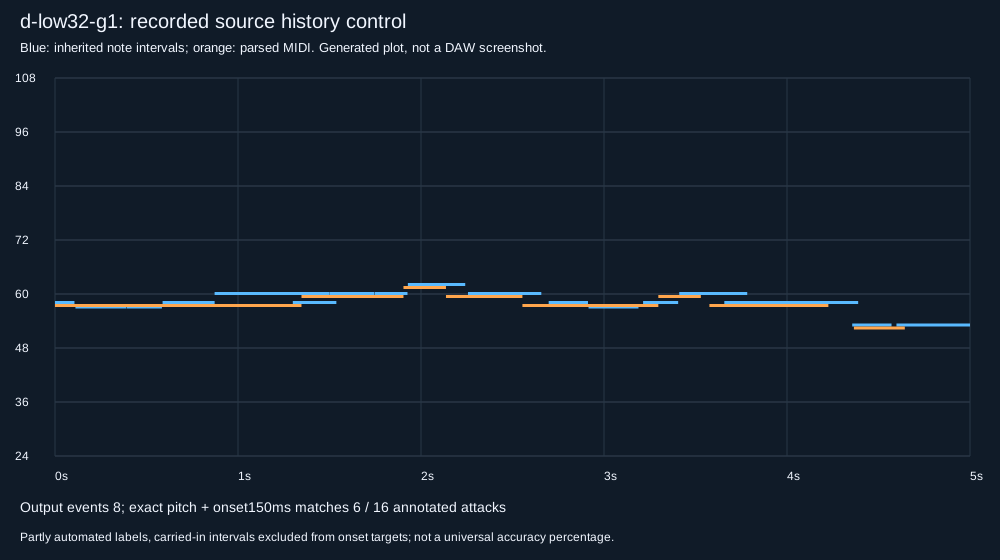
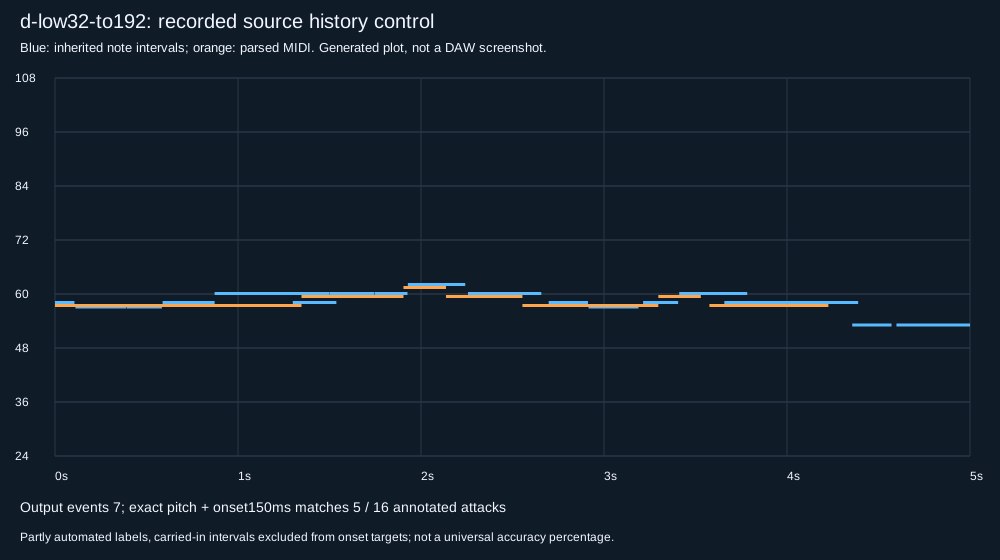
A’s direct and lossy-history 192 kb/s files each exported the same eight pitches in order, yet pitch 62 began about 279.167 milliseconds earlier and lasted equally longer after the low-rate history. Data
A’s direct 192 kb/s waveform was closer to the original by full-scale RMS error, about 0.001600 versus 0.005854, but had three exact-pitch onset matches versus four for the lossy-history draft under the declared matching rule. Data
B’s two 192 kb/s drafts retained the same matched pitch-70 attack, but the lossy-history start moved 46.875 milliseconds earlier while its ending stayed fixed, extending the stored note by 46.875 milliseconds. Data
The lossy-history 192 kb/s path lost a repeated pitch-58 event in C and pitch 53 in D relative to the direct path, reducing exact-pitch onset matches from six to five in each; D’s original low-rate pitch-53 event had already matched its annotated attack within about 9.258 milliseconds. Data
A: direct 192 · A: low32 then 192 · A: direct MIDI · A: history MIDI · B: direct ledger · B: history ledger · D: before resave · D: after resave
5. Control three: another lossy generation can change a different field
In A, the higher-rate resave preserved every pitch, start and duration but lowered four of eight velocities by one, while the second-to-third 32 kb/s pass preserved those same fields for seven events and lowered all seven velocities by one. Data
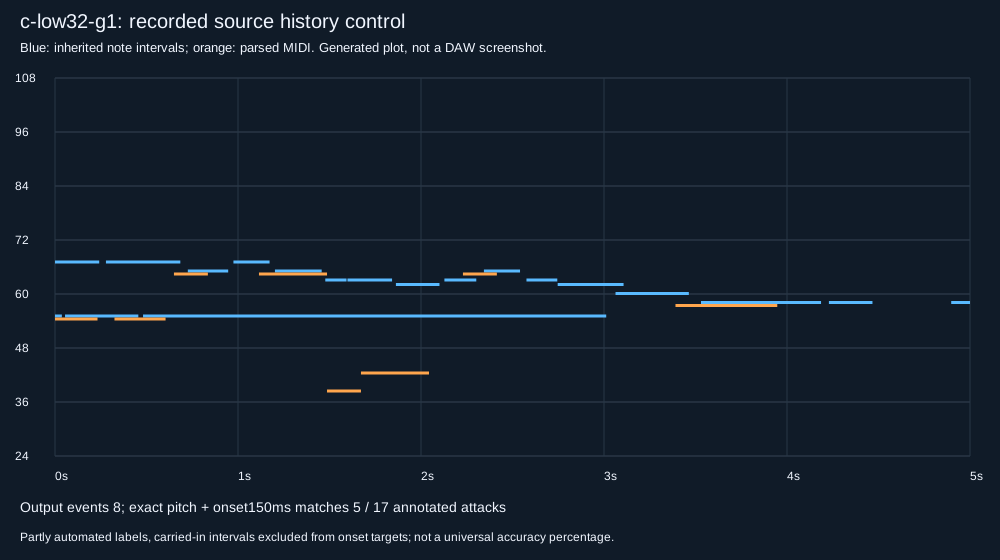
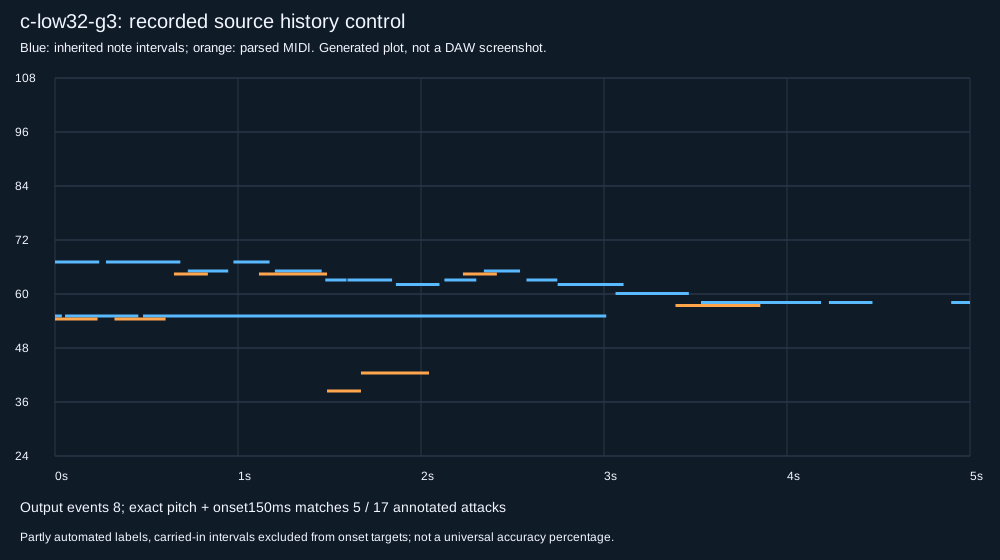
A second 32 kb/s pass removed A’s pitch-58 event and D’s pitch-53 event, reducing exact-pitch onset matches from four to three and six to five respectively, while B and C kept their prior match counts. Data
Across B’s three low-rate generations, pitch 70 started at about 3.204167, 3.251042 and 3.204167 seconds, but the third ending was about 138.542 milliseconds earlier than the first, so a returned onset did not restore the original note. Data
Across C’s three low-rate generations, all eight pitches and starts stayed fixed, yet the final pitch-58 duration shortened from 0.556250 to about 0.510417 and 0.463542 seconds, a total loss of about 92.708 milliseconds. Data
A: first-pass notes · A: second-pass notes · B: first-pass MIDI · B: third-pass MIDI · C: first-pass Piano Roll · C: third-pass Piano Roll · Complete field comparisons
6. Inspect and reproduce in a fixed order
Keep the earliest source and its existing MP3, run the unchanged conversion on both, then compare pitch, attack, release and velocity separately before deciding what to edit. Data
The independent checker accepts equal integer pitch at the nearest unused output onset within 150 milliseconds, one-to-one in reference order, without a duration or octave-equivalence acceptance gate. Data
GuitarSet labels are partly automated and include ringing, overlapping intervals; intervals already sounding at a crop boundary are plotted but excluded from new-attack match targets. Data
Fresh-directory regeneration with the archived encoder build reproduced 140 numerical files byte-for-byte; the four actual browser downloads are archived comparisons and are not counted as regenerated files. Data
python source-check.py
python generate.py --ffmpeg ffmpeg
node convert.mjs
python check.py
python compare.py
python browser-compare.py
Reproduction contract · Original WAV/JAMS check · Audio-path generator · Unchanged detector runner · Independent MIDI parser checks · Per-event arithmetic · Archived download comparison · Download SHA256 · Complete sentence ledger · Conservative sentence audit
7. Limits and source attribution
These correlated windows come from one performance, one encoder build and one detector setting, so their counts are neither population accuracy estimates nor evidence that WAV always gives a better transcription. Data
We did not test competing converters, listening preference or DAW import, and the browser equality check covers only the four stated operations. Data
The performance was already archived, but these source-history controls were run on November 11, 2026, without changing the detector or the earlier synthetic-test data. Data
Qingyang Xi and colleagues provide GuitarSet 1.1.0 under CC BY 4.0; our cropping, encoding, metadata edits, MIDI measurements and plots are modifications without implied endorsement. Data
8. Choose the next check
Use the browser converter for a first draft, the silence-and-context test for trim placement, and the quiet-note test for a sensitivity decision; preserve a dated source copy before changing either audio or MIDI. Data
Archived September 24 synthetic observations · GuitarSet source · MIDI file overview · Technical source notes