MP3 to MIDI Converter: A Single-Note Silence Test
For a single-note MP3 to MIDI conversion, compare pitches, starts and endings after adding or removing silence; identical retained audio was not enough to keep the exported notes identical in our recorded control. Data
This method performs monophonic pitch detection, one note at a time; simultaneous polyphonic transcription requires a different processing path. Data
2. Keep the same phrase and inspect the file fields
We encoded a real GuitarSet microphone excerpt from 12.12 to 16.86 seconds once at 192 kb/s and decoded it once to 44,100 Hz signed-16-bit PCM, then made WAV copies for cropped and zero-padded diagnostics. Data
All six inputs retain exactly the same PCM for the 13.12–15.86-second phrase, with Balanced mode fixed and the production detector unchanged. Data
The parsed exports in this run use format 0, one track, 480 ticks per quarter note and a tempo of 500,000 microseconds per quarter note; those fields describe the MIDI timeline rather than an audio quality score. Data
Recorded MP3 · Recorded source WAV · Published note references · MIDI file overview
3. Context versus a tight trim
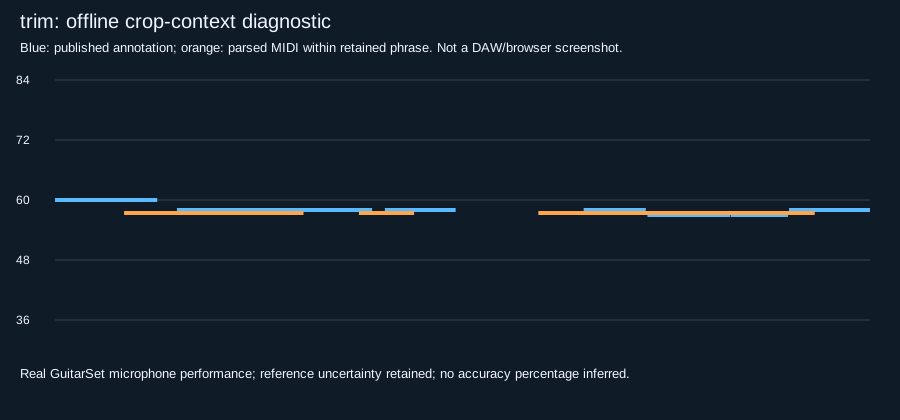
The longer context produced four events overall, while the trimmed file produced three; both contained three pitch-58 events inside the retained phrase. Data
After subtracting each input’s known phrase offset, corresponding note starts differed by as much as 25 milliseconds between the context and trim. Data
The third context event lasted 1.625 seconds overall and overlapped about 1.138958 seconds of the retained phrase, compared with about 0.929167 seconds for the trimmed event. Data
That event’s velocity changed from 71 in context to 79 after trimming, while the first two velocities stayed at 56 and 54. Data
Context WAV · Trim WAV · Context MIDI · Trim MIDI · Aligned context ledger · Trim Piano Roll
4. Leading silence is not always just an offset
Prepending 20,480 zero samples, exactly ten detector hops at this source rate, preserved the raw detected pitch, duration and velocity values and the offset-corrected starts within floating-point precision. Data
The exported MIDI still had an offset-corrected onset residual of about 0.184240 milliseconds, reproduced by rounding both start times onto this writer’s 960-ticks-per-second grid. Data
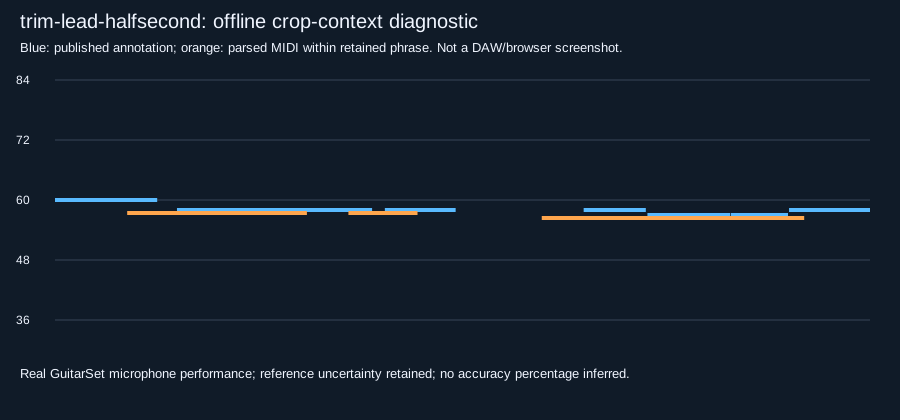
With 22,050 leading zero samples instead, a 0.5-second pad, the output still had three events but its last pitch changed from 58 to 57. Data
After removing that 0.5-second offset, the second exported note began about 35.417 milliseconds earlier than in the trimmed baseline. Data
Its stored duration also grew from about 185.417 to 232.292 milliseconds, although its pitch stayed at 58. Data
Ten-hop lead WAV · Ten-hop MIDI · Half-second lead WAV · Half-second lead MIDI · Leading-pad ledger · Leading-pad Piano Roll
5. Trailing silence tests a different boundary
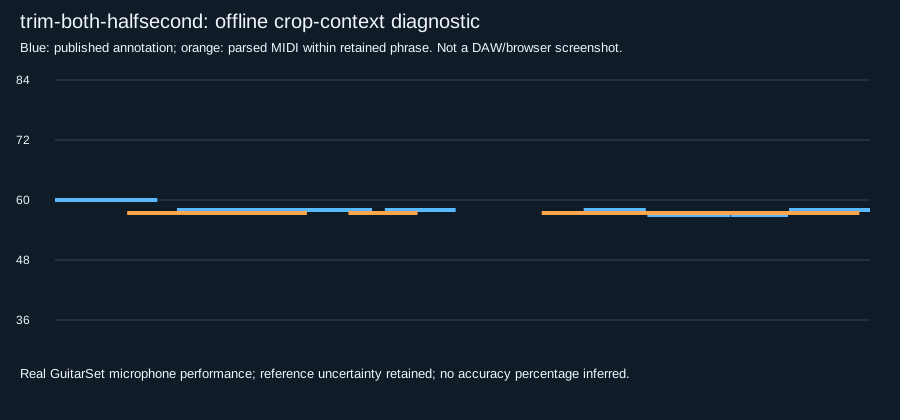
Adding 0.5 seconds after the trimmed phrase left the first two exported events identical in pitch, start, duration and velocity. Data
The third event’s stored duration increased by about 139.583 milliseconds to 1.068750 seconds. Data
Its velocity fell from 79 to 77 while its pitch and start stayed unchanged. Data
When a 0.5-second tail was also added to the 0.5-second-leading condition, the last pitch returned from 57 to 58. Data
That interaction does not establish a universally correct amount of padding or a better transcription. Data
Tail-only WAV · Tail-only MIDI · Both-ends WAV · Both-ends MIDI · Tail ledger · Both-ends Piano Roll
6. Compare the same interval and reproduce the controls
Keep the original context, make the intended trim, then compare both drafts over the same offset-corrected target interval. Data
Check pitch, start, ending and velocity separately, since an unchanged event count did not establish equality in those fields here. Data
The checker clips note overlap to a shared 2.74-second region and subtracts its declared input offset, while preserving the whole-file event list separately. Data
Reproduction commands
Run the supplied generator, unchanged detector snapshot and independent Python MIDI parser in a fresh directory with the recorded FFmpeg build before comparing hashes. Data
python generate.py --ffmpeg ffmpeg
node convert.mjs
python check.py
python compare.py
Generator · Unchanged detector runner · Independent MIDI checker · Field arithmetic · Original-source check · Complete reproduction contract · SHA256 manifest · Whole-page sentence ledger
7. What this test establishes
These six offline inputs come from one human acoustic-guitar performance and do not measure browser decoding, file-picker conversion, DAW import, listening preference or competing services. Data
GuitarSet’s partly automated reference labels include notes crossing the crop boundary; they are not a fresh hand-checked accuracy standard. Data
The performance was previously archived, while the shared-decode context and padding comparisons were run on November 10, 2026, without changing earlier experimental outputs. Data
The GuitarSet authors provide version 1.1.0 under CC BY 4.0; our cropping, encoding, padding, measurements and plots are modifications without implied endorsement. Data
8. Choose the next check
Use the MP3 to MIDI converter and recorded baseline controls for conversion, the format comparison for encoding questions, and the quiet-note test for a sensitivity decision. Data
If an attack was actually cut off, use the separate crop-boundary check; these controls keep the target phrase’s PCM intact and vary its surrounding context or silence. Data